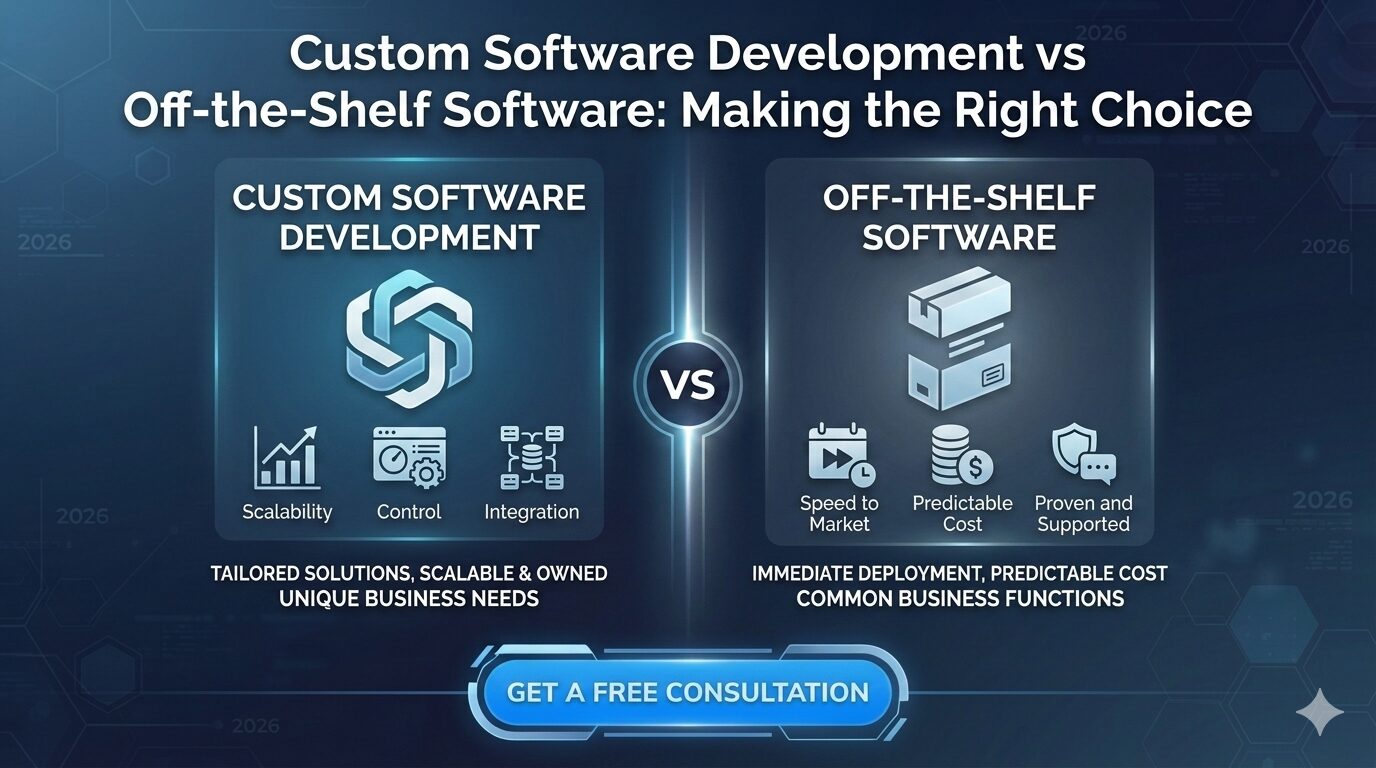
Custom Software Development vs Off-the-Shelf Software: Making the Right Choice

SUMMARY
custom software is worth the cost when your business has workflows, scale, or integration needs that off-the-shelf tools can’t match — the higher upfront investment pays off through better fit, no per-seat fees, and full ownership. For simpler, standard needs, off-the-shelf software is usually the faster, cheaper option. Every growing business eventually hits the same […]
custom software is worth the cost when your business has workflows, scale, or integration needs that off-the-shelf tools can’t match — the higher upfront investment pays off through better fit, no per-seat fees, and full ownership. For simpler, standard needs, off-the-shelf software is usually the faster, cheaper option.
Every growing business eventually hits the same fork in the road: keep bolting together off-the-shelf tools, or invest in custom software built around how the business actually works. Both paths are valid — the right one depends on your budget, timeline, and how unique your processes really are. This guide breaks down the real differences in cost, flexibility, and scalability so you can make the call with confidence.
What’s the Difference Between Custom and Off-the-Shelf Software?
Off-the-shelf software is a pre-built product — think project management tools, accounting platforms, or CRMs — designed to serve a broad range of businesses with the same core features. Custom software development, by contrast, is built specifically for your business: your workflows, your data structures, your integrations, and your growth plan. Neither is inherently better; they solve different problems.
Custom Software vs Off-the-Shelf: Pros and Cons at a Glance
Here’s a side-by-side breakdown of how the two approaches compare across the factors that matter most when making this decision:
| Custom Software | Off-the-Shelf Software | |
|---|---|---|
| Upfront Cost | Higher — built from scratch around your requirements | Lower — subscription or one-time license fee |
| Time to Launch | Longer — weeks to months for development | Faster — ready to use immediately or with light setup |
| Fit to Your Process | Exact — built around your workflows | Generic — you adapt your process to the tool |
| Scalability | High — architecture grows with the business | Limited — capped by the vendor’s roadmap and pricing tiers |
| Ongoing Cost | Maintenance and hosting, but no recurring license fees | Recurring subscription costs that scale with usage/seats |
| Ownership | Full ownership of code and data | Vendor controls the roadmap, pricing, and data policies |
When Off-the-Shelf Software Makes Sense
Off-the-shelf tools are the right call when your needs are standard, your budget is limited, or you need to move fast. This includes:
- Early-stage startups validating an idea before committing to a big build
- Businesses with common, well-understood processes (basic accounting, standard CRM needs)
- Teams that need a working solution within days or weeks, not months
- Situations where a lower upfront cost matters more than a perfect fit
The trade-off is flexibility. As the business grows, off-the-shelf tools often require workarounds, extra integrations, or a switch to a more capable (and more expensive) tier — costs that add up over time.
When Custom Software Development Makes Sense
Custom software earns its higher upfront cost when your business has needs that generic tools weren’t built to handle. This includes:
- Unique or complex workflows that don’t map cleanly onto a generic tool
- Industry-specific compliance or data-handling requirements
- A need to integrate deeply with existing/legacy systems
- Plans to scale significantly, where per-seat or per-usage pricing would become expensive
- A desire to own your codebase and data outright, without vendor lock-in
Companies like Codieslab build custom software development projects specifically around these scenarios — designing the system once around the real workflow instead of forcing the business to adapt to someone else’s product.
Decision Framework: Which One Fits Your Business?
Use this matrix as a starting point to map your business profile to the right approach:
| Business Profile | Budget | Timeline | Scalability Need | Recommended Path |
|---|---|---|---|---|
| Early-stage startup, unproven idea | Limited | Need to launch in weeks | Low to moderate | Off-the-shelf |
| Growing SMB with standard processes | Moderate | 1-3 months | Moderate | Off-the-shelf or hybrid |
| SMB with unique workflows or compliance needs | Moderate to high | 2-4 months | Moderate to high | Custom software |
| Mid-market company scaling fast | Moderate to high | 3-6 months | High | Custom software |
| Enterprise with legacy systems to integrate | High | 6+ months | High | Custom software |
| Enterprise needing a quick internal utility | Low to moderate | Weeks | Low | Off-the-shelf |
If your business profile sits closer to the custom software rows — unique workflows, integration needs, or plans to scale — it’s worth getting a professional assessment before defaulting to an off-the-shelf tool that may not hold up long-term.
Get a Free Consultation
Total Cost of Ownership: The Number That Actually Matters
Comparing sticker prices alone is misleading. Off-the-shelf software looks cheaper on day one, but recurring per-seat fees, add-on modules, and workarounds compound over several years. Custom software has a higher initial cost but no recurring license fees — just maintenance and hosting. For businesses planning to operate and scale over 3-5+ years, the total cost of ownership often favors custom development, even though the upfront number is larger.
A Hybrid Approach Is Often the Right Answer
Many businesses don’t need to choose one path exclusively. A common approach is to start with off-the-shelf tools to validate the business, then move to custom software development for the specific workflows that become bottlenecks as the company scales — keeping standard functions (like accounting) on off-the-shelf platforms while building custom systems only where they create real competitive advantage.
Frequently Asked Questions
Is custom software worth the cost?
For businesses with unique workflows, compliance needs, or plans to scale, yes — custom software typically pays off through better process fit, no recurring license fees, and full ownership of the codebase, even though the upfront cost is higher than off-the-shelf tools.
How long does custom software development take?
Most custom software projects take anywhere from two to six months depending on scope, integrations, and complexity, compared to the days or weeks it takes to deploy an off-the-shelf tool.
Can I switch from off-the-shelf software to a custom system later?
Yes — many businesses start with off-the-shelf tools and migrate to custom software once specific workflows outgrow what the generic tool can support, typically once integration or scalability limits start creating real friction.
Final Thoughts
The choice between custom software development and off-the-shelf software isn’t about which is better in the abstract — it’s about matching the tool to your business’s actual complexity, budget, and growth plans. If your processes are standard and your timeline is short, off-the-shelf software will serve you well. If your workflows are unique, your integrations are complex, or you’re planning to scale significantly, custom software development is usually the investment that pays off. Codieslab works with businesses at both stages to figure out which path actually fits, and to build the right solution when custom development is the answer.
Explore More
 WATCH VIDEO