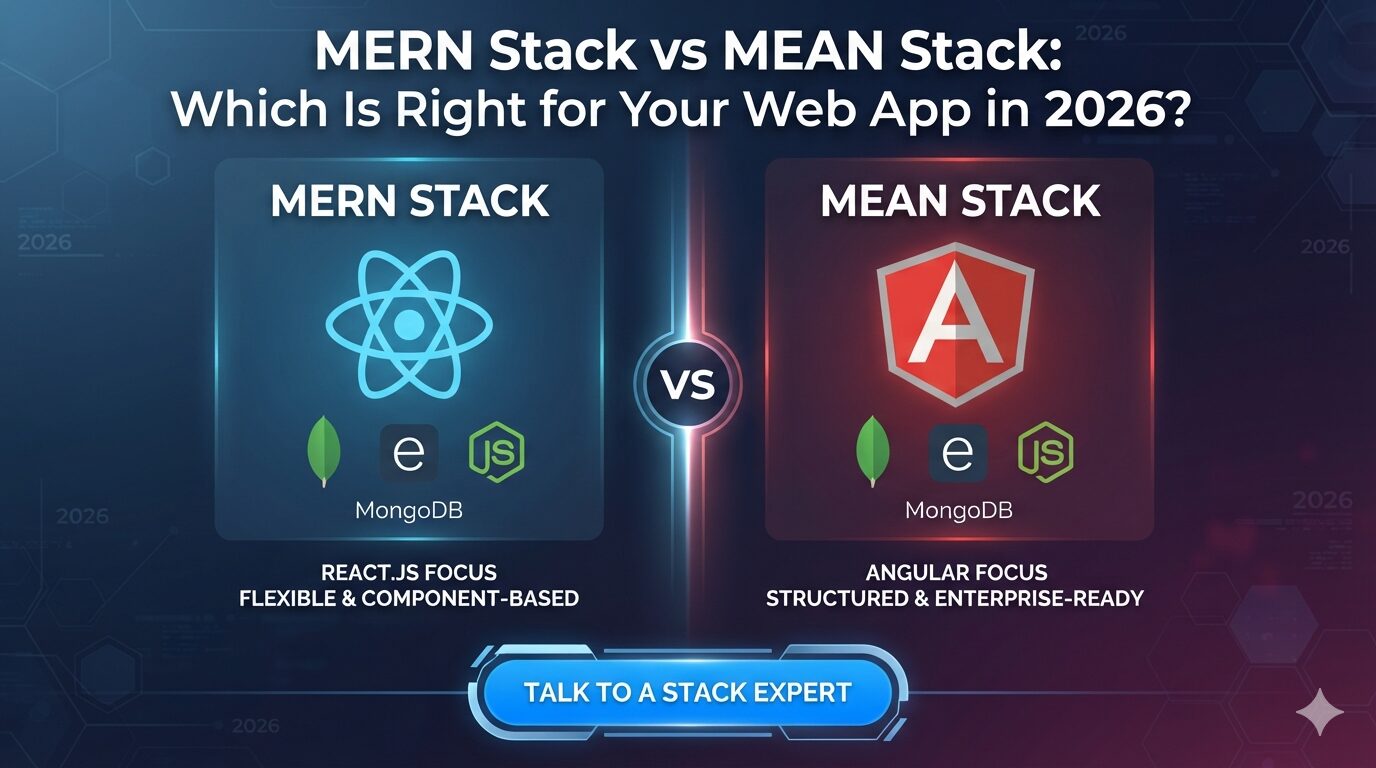
MERN Stack vs MEAN Stack: Which Is Right for Your Web App in 2026?

SUMMARY
MERN Stack vs MEAN Stack : MERN (MongoDB, Express, React, Node.js) is better for fast-moving startups and content-driven apps that need quick iteration and a large talent pool, while MEAN (MongoDB, Express, Angular, Node.js) suits large enterprise applications that benefit from Angular’s built-in structure and TypeScript-first discipline. Neither stack is universally “better” — the right […]
MERN Stack vs MEAN Stack : MERN (MongoDB, Express, React, Node.js) is better for fast-moving startups and content-driven apps that need quick iteration and a large talent pool, while MEAN (MongoDB, Express, Angular, Node.js) suits large enterprise applications that benefit from Angular’s built-in structure and TypeScript-first discipline. Neither stack is universally “better” — the right choice depends on your team, timeline, and app complexity.
If you’re planning a new web application in 2026, choosing between MERN and MEAN is one of the first technical decisions you’ll make — and it shapes your hiring, timeline, and long-term maintenance costs. Both stacks share three of four layers (MongoDB, Express.js, Node.js) and differ only in the frontend framework: React for MERN, Angular for MEAN. That single difference, though, has a bigger impact than it sounds.
What Do MERN stack vs MEAN stack Actually Mean?
Both stacks are full-stack JavaScript solutions, meaning your team writes both frontend and backend code in the same language. This reduces context-switching and lets developers move between layers of the application more easily.
- MERN: MongoDB (database) + Express.js (backend framework) + React (frontend library) + Node.js (runtime)
- MEAN: MongoDB (database) + Express.js (backend framework) + Angular (frontend framework) + Node.js (runtime)
The core difference comes down to React vs Angular. React, maintained by Meta, is a UI library that gives developers flexibility in how they structure an app. Angular, maintained by Google, is a complete framework with routing, forms, and state management built in, enforced through TypeScript.
MERN vs MEAN: Side-by-Side Comparison
Here’s how the two stacks compare across the factors that matter most for a 2026 web app project:
| Factor | MEAN Stack (Angular) | MERN Stack (React) |
|---|---|---|
| Frontend Framework | Angular 18 (full framework, TypeScript-first) | React 19 (UI library, flexible tooling) |
| Backend & DB | Node.js, Express.js, MongoDB | Node.js, Express.js, MongoDB |
| Learning Curve | Steeper — opinionated structure, more concepts upfront | Gentler — component model is quicker to pick up |
| Performance | Strong for large enterprise apps with complex forms | Fast rendering via virtual DOM; excels in dynamic UIs |
| Best Use Cases | Enterprise dashboards, banking portals, large internal tools | Startups, SaaS products, content-heavy or interactive apps |
| Talent Pool (2026) | Smaller, more specialized developer pool | Larger, more widely available developer pool |
| Scalability | Good, with built-in structure for large teams | Excellent, especially with Next.js for SSR at scale |
| Time to Market | Slower initial setup due to boilerplate | Faster prototyping and MVP delivery |
Talk to a Stack Expert
When to Choose MERN Stack Development
MERN stack development is the stronger choice when speed, flexibility, and a larger hiring pool matter more than built-in structure. React 19’s component model and hooks-based architecture make it well suited to:
- Startup MVPs where requirements will change quickly
- Content-heavy platforms, marketplaces, and SaaS dashboards
- Apps that need server-side rendering via Next.js for SEO and performance
- Teams that want a shallower learning curve and faster onboarding
Because React has one of the largest developer communities in the world, sourcing MERN stack developers is generally faster and more cost-effective than sourcing Angular specialists, which matters when you’re scaling a team quickly.
When to Choose MEAN Stack Development
MEAN stack development tends to win in enterprise contexts where consistency across a large team matters more than raw speed. Angular 18’s opinionated structure, dependency injection, and TypeScript-first approach reduce the risk of inconsistent code patterns across large teams. It’s a strong fit for:
- Enterprise dashboards and internal tools with complex forms
- Banking, insurance, and regulated industry applications
- Long-lifecycle projects where strict typing reduces long-term bugs
- Teams that already have Angular/TypeScript expertise in-house
Performance in 2026: What’s Actually Changed
Both ecosystems have matured. React 19 introduced further improvements to concurrent rendering and server components, making MERN apps faster for dynamic, data-heavy interfaces. Angular 18’s standalone components and improved hydration have narrowed the gap for enterprise apps that previously chose Angular purely for performance reasons. In practice, performance differences between the two stacks are now smaller than differences caused by poor architecture or unoptimized database queries — so the framework choice should be driven more by team fit and use case than by raw benchmarks.
Cost and Hiring Considerations
Because MongoDB, Express.js, and Node.js are identical in both stacks, your backend cost and hiring pool won’t change much between MERN and MEAN. The real cost difference shows up on the frontend: React developers are more widely available and, on average, less expensive to hire than experienced Angular developers, which can shorten your hiring timeline for a MERN project. MEAN projects may cost more upfront in hiring but can reduce long-term maintenance costs on large codebases thanks to Angular’s enforced structure.
Quick Decision Guide
- Building a startup MVP or SaaS product fast? Choose MERN.
- Need a highly structured enterprise application with a large dev team? Choose MEAN.
- Want the largest possible talent pool for future hiring? Choose MERN.
- Already have an Angular/TypeScript team? Choose MEAN.
- Not sure? A quick technical consultation can map your requirements to the right stack before you commit.
Frequently Asked Questions
Is MERN better than MEAN?
Neither is universally better — MERN is generally faster to build and easier to hire for, while MEAN offers more built-in structure for large enterprise teams. The right choice depends on your project size, timeline, and existing team skills.
Which stack is faster to develop with?
MERN stack development is typically faster to get off the ground because React has a shallower learning curve and a larger ecosystem of pre-built components, which speeds up MVP timelines.
Can I switch from MEAN to MERN later?
Since both stacks share the same backend (Node.js, Express.js, MongoDB), migrating the frontend from Angular to React is possible without rebuilding your entire backend, though it still requires careful planning and testing.
Final Thoughts
MERN and MEAN both give you a fully JavaScript-based stack with a shared backend foundation, so the decision really comes down to your frontend needs: React’s flexibility and speed for MERN, or Angular’s structure and discipline for MEAN. Mapping that decision to your specific app, team, and timeline is where an experienced development partner makes the difference.
Explore More
→ Why Laravel + VueJS Is a Smart Combo for Modern Web Apps
 WATCH VIDEO